Fotovyn
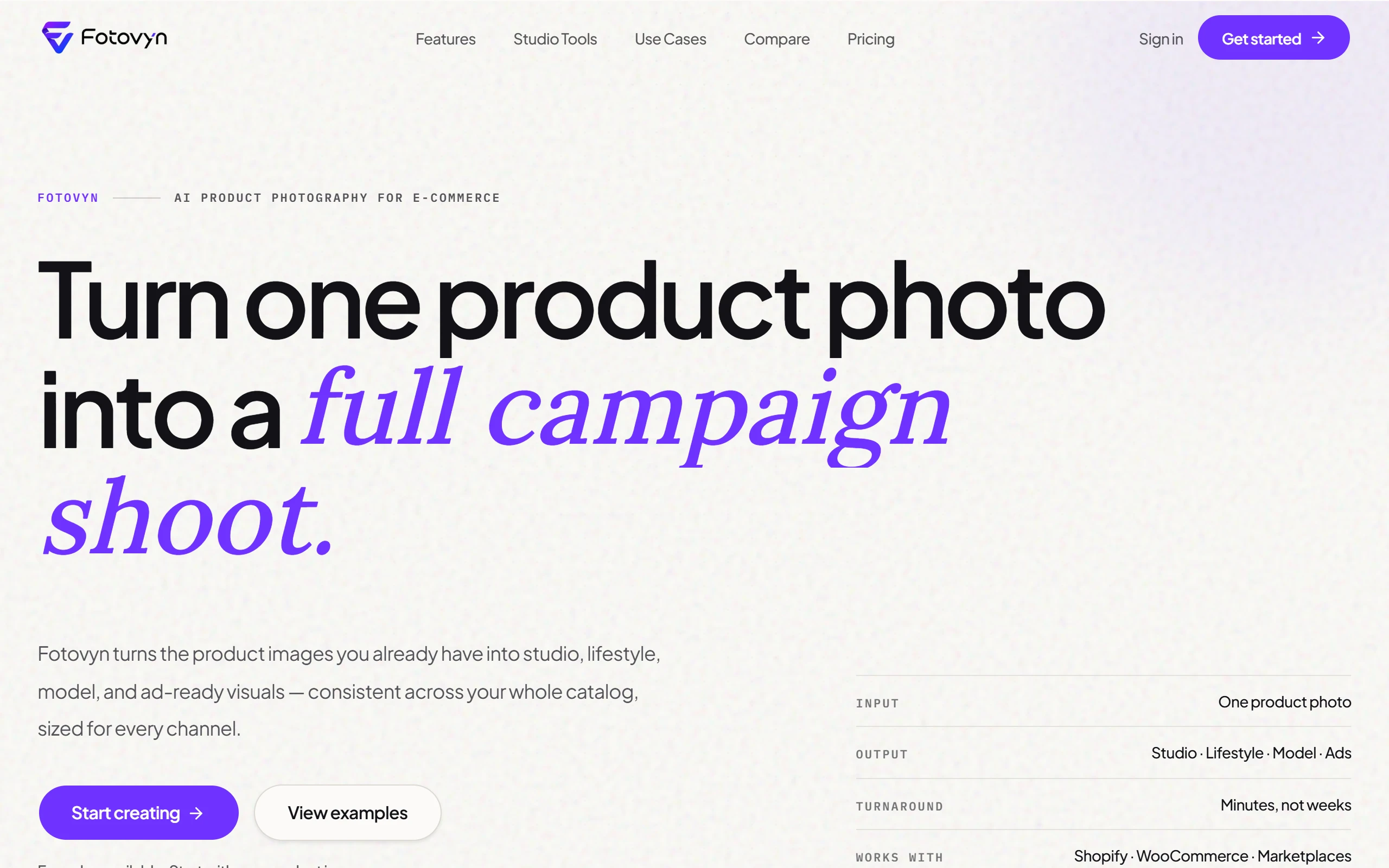
An AI product photography and visual content platform for e-commerce sellers, fashion brands, creators, and agencies.
Role
Founder & sole engineer — AI pipelines, product, platform
Stack
- Next.js
- TypeScript
- Diffusion model APIs
- Queue workers
- PostgreSQL
- Object storage
The problem
Product photography is the single largest recurring cost for small e-commerce sellers — studio time, models, reshoots for every variant. Generic image models get you a nice picture, not a usable catalogue asset with the right product, the right framing and the right consistency across a range.
Approach
- 01Built seven distinct visual workflows — studio shots, lifestyle scenes, model try-ons and more — rather than one generic prompt box, so each job runs a pipeline tuned to its output.
- 02Grounded generation in the seller's actual product images so the result is their item, not a plausible lookalike.
- 03Ran everything through a durable job queue with explicit states, so a slow or failed generation is visible and retryable instead of silently lost.
- 04Made cost observable per generation — the platform is only viable if the unit economics stay legible to both the seller and the operator.
System
A generation is a job, not a request. Every submission enters a durable queue with explicit states, so a slow or failed run is visible and retryable rather than silently lost — and every run books its own cost.
Seller
- Product images
- Workflow picker
- Job submission
Edge
- Next.js route handlers
- Validation + quota
Queue
- Durable job queue
- Explicit job states
- Retryable failures
Generation
- Per-workflow pipeline
- Diffusion model APIs
- Grounded on the seller's product
Data
- PostgreSQL
- Object storage
- Per-generation cost ledger
Job state streams back to the seller — queued, running, failed, done — so a generation is never a black box with a spinner on it
Trade-offs
What was rejected, and why.
Seven distinct workflows, each running its own tuned pipeline.
Instead ofOne generic prompt box.
A prompt box produces a nice picture. A catalogue needs the right product, the right framing and consistency across a range — and those are different pipelines, not different prompts.
Generation grounded in the seller's actual product images.
Instead ofText-to-image from a description of the product.
An ungrounded model returns a plausible lookalike. A seller cannot list a lookalike — it is the wrong item, and it is a returns problem wearing a marketing asset's clothes.
Cost tracked and surfaced per generation.
Instead ofAggregate infrastructure spend reconciled monthly.
The unit economics have to stay legible to both sides. A per-asset price the seller cannot see is a platform that discovers it is unprofitable a quarter too late.
Outcome
- Seven production visual workflows in one platform.
- Catalogue-ready output without booking studio time.
Next project
Menuvyn